Joy Wadimo is the Special Education head teacher at Kamurasi Demonstration School in Masindi Municipality, Uganda.
Wadimo says: “I have been a teacher in Uganda for 26 years. I believe assistive technology is a blessing to the growing minds of children with disabilities in Uganda today. In last year’s Primary School finals, one of my students with disabilities received a better score than all the other candidates. I know this success was due to the full-time availability of the assistive he uses.”
Assistive technology means products, devices and related services that improve the functional environment of people with disabilities. It is instrumental for children’s development and health, as well as for participation in various facets of life. There is a vast range of assistive technology on a continuum from low- to high-tech. Assistive technologies can be divided into several categories, including: mobility (e.g. walking stick), hearing (e.g. hearing aids), visual (e.g. screen reading software), communication (e.g. communication cards with text), and cognition (e.g. image-based instructions).
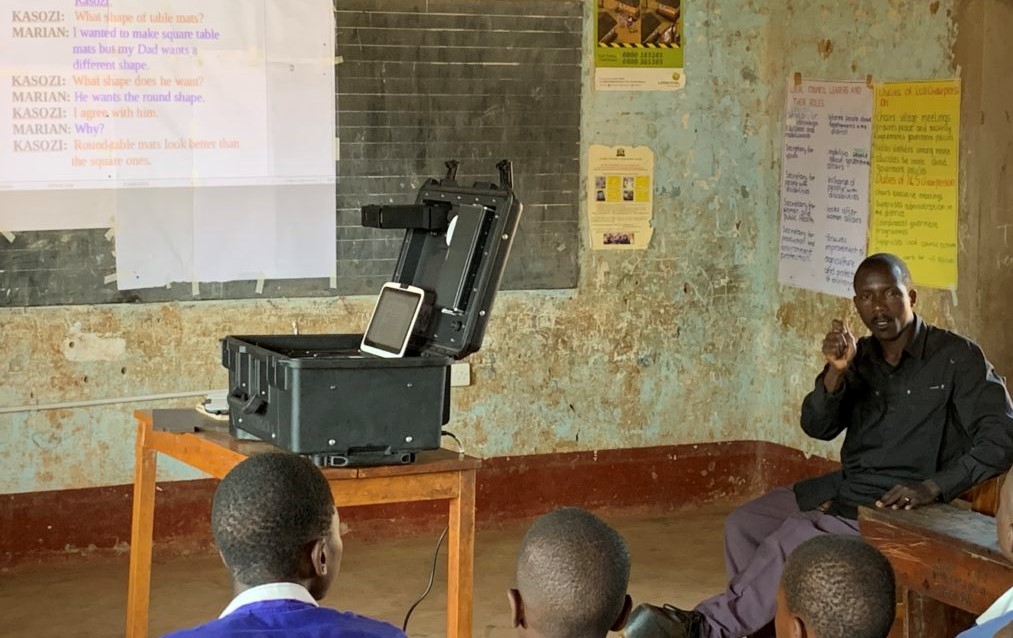
Kamurasi Demonstration School in Masindi Municipality, Uganda, is one of the many pilot schools using assistive technology in teaching and learning processes. Hearing aids, glasses and laptops with accessible textbooks installed are some of the examples of technological devices developed to support children with a range of disabilities. Wadimo states that “to be able to manage an inclusive class, including children with disabilities and different age groups under one roof, you need this assistive technology. For example, you need audio materials for pupils who are blind or have low vision, and you need to be able to project sign language videos for pupils who are deaf.”
UNICEF and its partners are driving an innovative solution called Accessible Digital Textbooks for All, to make textbooks available, affordable and accessible for children with disabilities in all contexts. Everyone cherish the printed word, but it isn’t always accessible to everyone. Children with disabilities remain one of the most marginalized and excluded populations and, for them, access to quality education can often be challenging. By adding specific features to digital formats and following the principles of Universal Design for Learning, textbooks can be made accessible to all students who need them. And it doesn’t stop there: these features can enrich the learning experience for all children. UNICEF is currently piloting the Accessible Digital Textbooks for All Initiative in Kenya, Uganda, Rwanda, Nicaragua, Paraguay and Uruguay.
“I have realized an important truth: children with disabilities are more independent and more engaged when using assistive devices and accessible textbooks. As compared to when they only depend on their teacher for their learning, these inclusive devices offer a bit of freedom. These devices have increased girls’ and boys’ passion for learning. In school, many pupils are seen following along with their teacher using accessible digital textbooks. And during lessons, hundreds of pupils are seen peering into classrooms outside of windows or doorways to follow classes taught with the accessible textbooks projected on a screen. They want to be part of a lesson at any time. Also, teachers like me wish to move away from traditional methods where teachers merely talk and talk to their pupils. Girls and boys with disabilities have the right to grow, acquire skills for adulthood and become independent, self-reliant individuals and members of their communities. And indeed, given this fair chance, they can excel. We have seen this success elsewhere in the world. My wish is to witness this success here in Uganda before I retire.”
Source: UNICEF website