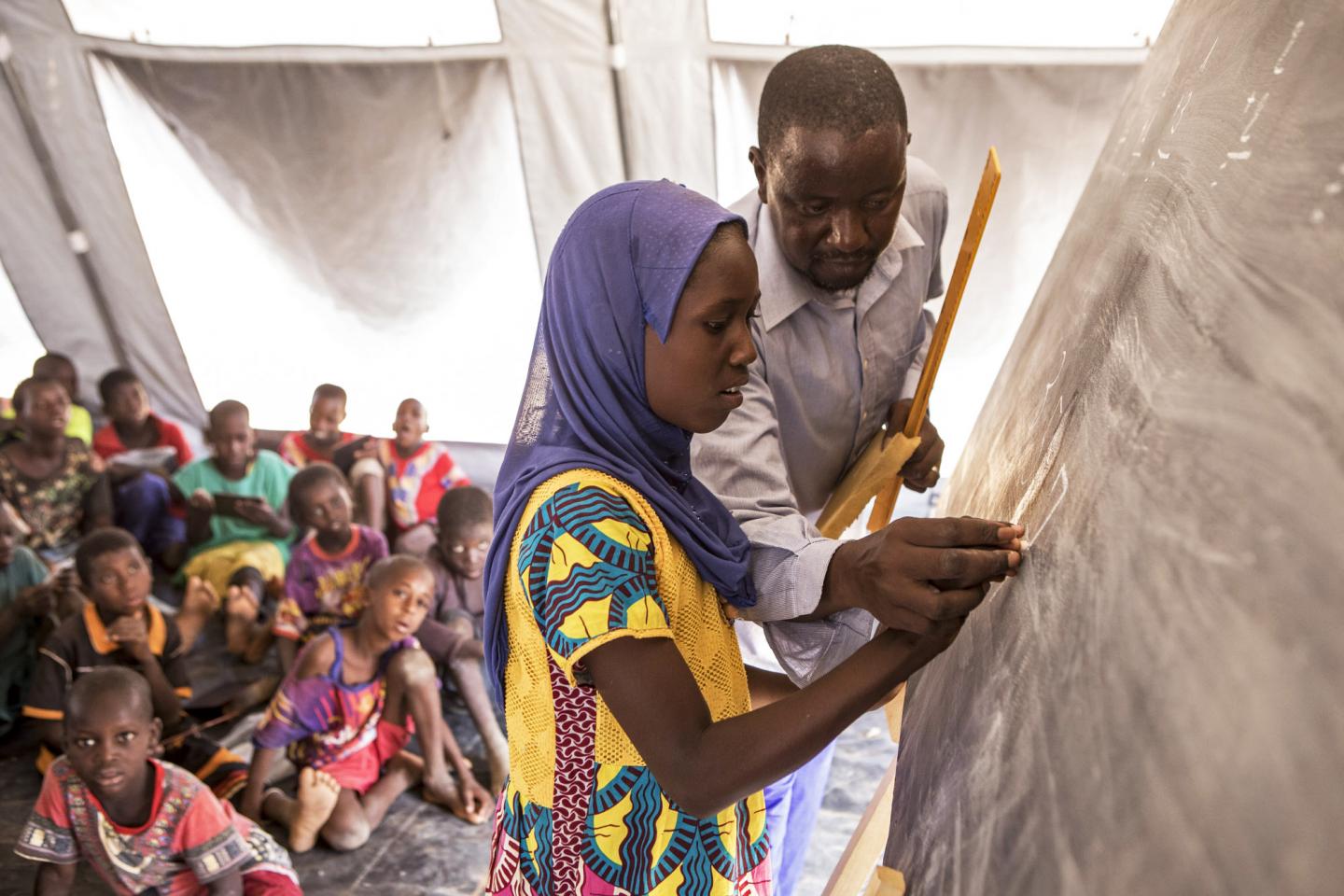
Ongoing violence in the Mopti region has forced hundreds of schools to close. But a teacher and student show that education can still thrive in even the most challenging places.
Boureima's students enjoyhis classes. The setting be unconventional, uncomfortable even, with more than 70 students sharing a tent in the corner of a dusty sports stadium. But Boureima brings something even more valuable than sturdy walls of conventionam classroom: Seemingly unlimited patience - and pride in his students.
"Some students were shy until they saw they wouldn't be punished," he says, explaining that for many children, sturdy and punishement have too often gone hand in hand. "But when they see that isn't the case in our learning space, that we just want students to make progress, they really start to try."
The tent is one of several temporary learning spaces set up by UNICEF and the Government of Mali in Sévaré, on the outskirts of Mopti city in central Mali, to help children displaced by insecurity and the intercommunal violence continue their education. The spaces aim to provide both a safe haven and a foundation for formal education. In some cases, the learning spaces have enrolled children who never had the chance to attend a regular school.
Boureima's ability to project a welcoming attitude towards students is about more than just being qualified to do the job. Being displced himself, he understands as well as anyone the need to show kindness to children who have fled horrific violence.
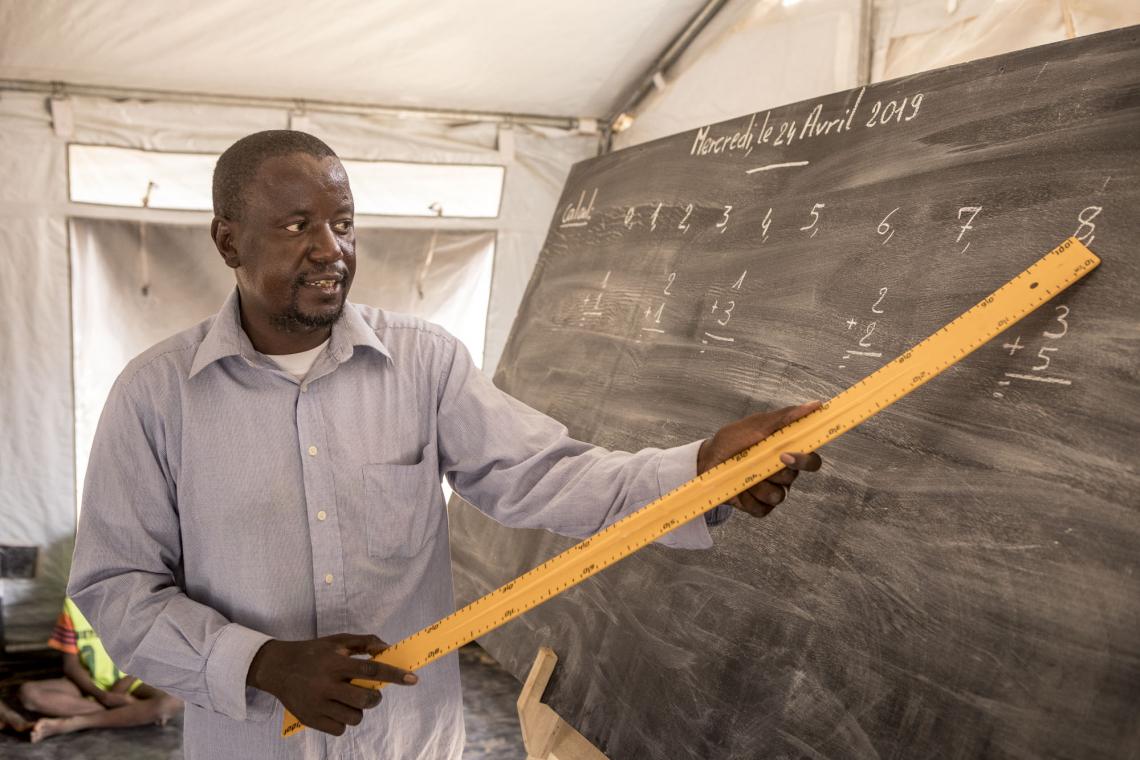
Boureima previously worked as a teacher in the town of Bankass, about 100 kilometres southeast of Sévaré. He says he enjoyed working there, teaching children from a range of backgrounds. But, as he began to hear more and more stories of kidnappings and killings in the area, he started to think about leaving. The killing of a relative and a devastating attack on the village of Ogossagou, which claimed the lives of 85 children, finally prompted him to head for Sévaré.
Now he’s making a real difference somewhere new. “There are some students who really have a head for studying, but because of the crisis they’ve had to quit school and flee,” he says. “They really want to understand. They ask me a lot of questions!”
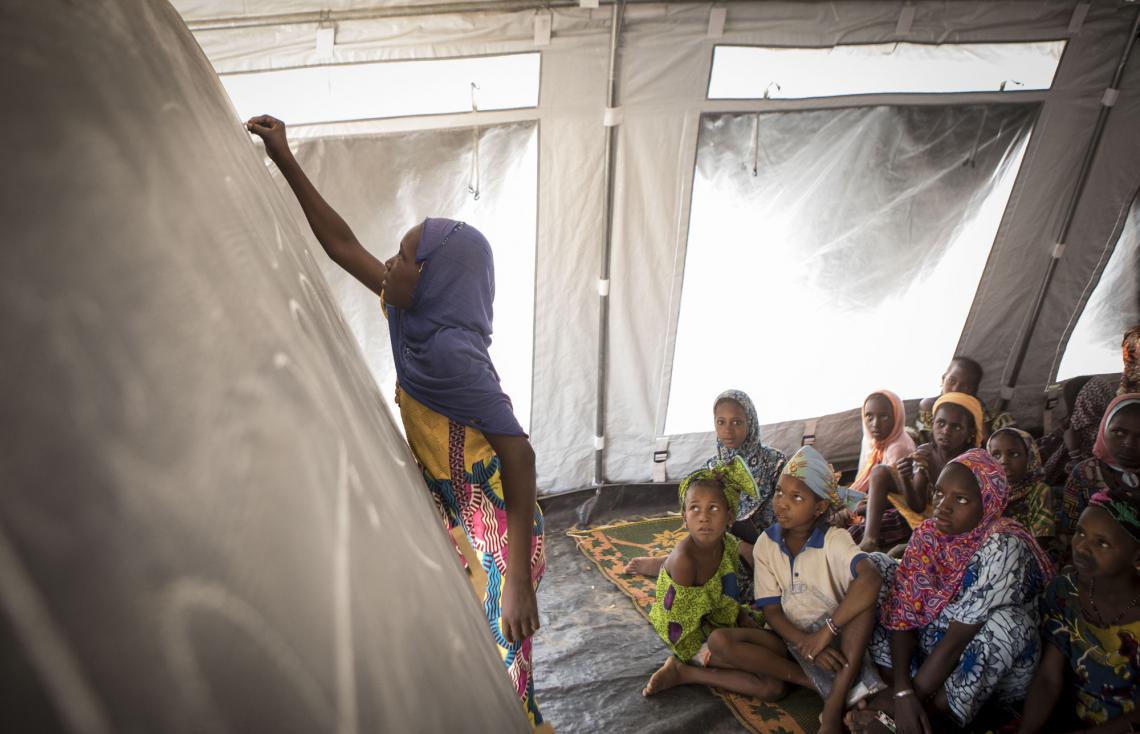
Eleven-year-old Rokiyatou is one of those students. Before the violence intensified, Rokiyatou was being taught by her uncle in a small school in the Douentza district of Mopti. But as the situation deteriorated, she and her father were forced to flee. They now live in a tent in the Socoura stadium in Sévaré, the main site for internally displaced persons in Mopti.
Rokiyatou enjoys Boureima’s classes: “I like him,” she says, before starting to sound out some of the letters she has been learning. “It’s easier learning my A,B,Cs than doing sums,” she adds, smiling.
Boureima is full of praise for Rokiyatou’s enthusiasm.
“She’s interested in my explanations, and she asks questions when she doesn’t understand something,” he says. “She really tries.”
The upheaval that Rokiyatou and her father have faced is all too familiar to thousands of families in central Mali.
Repeated attacks in the region, fueled by increasing intercommunal violence and the presence of armed groups, have claimed children’s lives, left others injured from gunshots or burns, and separated many young people from their families. The rising insecurity and a growing displacement crisis have in turn created a crisis in education, with hundreds of schools having been forced to close. By the end of the school year, more than 900 schools in Mali remained closed, affecting 276,000 children. The vast majority of these children are in the central region of Mopti.
The result for adults and children alike is a continued sense of uncertainty about what the future might bring – and where that future will unfold.
Boureima says he would like to return to his hometown and his life as a teacher. But he’s aware that that may not be possible anytime soon. “It’s what I want with all my heart. But returning before there’s peace won’t be easy.”
Rokiyatou says she’d like to be a school principal when she grows up. But when she’s asked where she thinks that might be, a look of uncertainty crosses her face. “I’ll be a principal wherever I happen to be.”
Source: UNICEF