Anesthesia refers to the practice of blocking the feeling of pain to allow medical and surgical procedures to be undertaken without pain.
An ancient Italian practice was to cover a patient’s head with a wooden bowl and beat on it repeatedly until the patient lost consciousness. Presumably this method resulted in a number of side-effects the patient would not have found beneficial.
Opium and alcohol were regularly used to produce insensibility, both of which also had a number of negative side effects and neither could dull the pain completely. Few operations were possible and speed was the determinant of a successful surgeon. Patients were often tied or held down and the abdomen, chest and skull were effectively inoperable. Surgery was a last, and extremely painful, resort.
On October 16, 1846, an American dentist, William Morton, proved to the world that ether causes complete insensibility to pain during an operation performed in front of a crowd of doctors and students at the Massachusetts General Hospital. Morton instructed the patient to inhale the ether vapor and, once the patient was suitably sedated, a tumor was removed from his neck. The patient felt no pain. This demonstration transformed medical practice.
News of Morton’s demonstration spread quickly in the pre-technological world. Within two months, London doctors Francis Boott and James Robinson had performed a tooth extraction using ether and two days after that, Robert Liston performed an amputation. Their exploits were written up the following January in the London Illustrated News which reached Australia in May 1847.
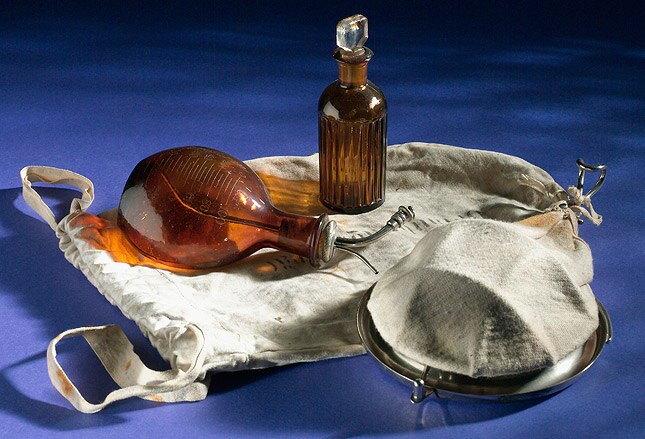
Launceston doctor, William Russ Pugh, and Sydney dentist, John Belisario, fashioned ether inhalers based on the diagram in the newspaper. On June 7, 1847, Pugh successfully performed two operations under ether anesthesia while Belisario performed two dental surgeries. Both had journalists present.
Ether was first used in New Zealand on September 27, 1847, when Colonial Surgeon James Patrick Fitzgerald performed a dental extraction on a prisoner at the Wellington jail. On the same day, Fitzgerald also performed New Zealand’s first general surgical operation on an anaesthetized patient. During both procedures, the ether was administered by Mr. James Marriott, an optical instrument maker, using a vaporizer of his own design.
Ether anesthesia not only resulted in a better surgical experience for the patient, it also allowed doctors time during surgery to develop more refined and complex surgical skills.